Inspect: walk the house every season, before the weather does
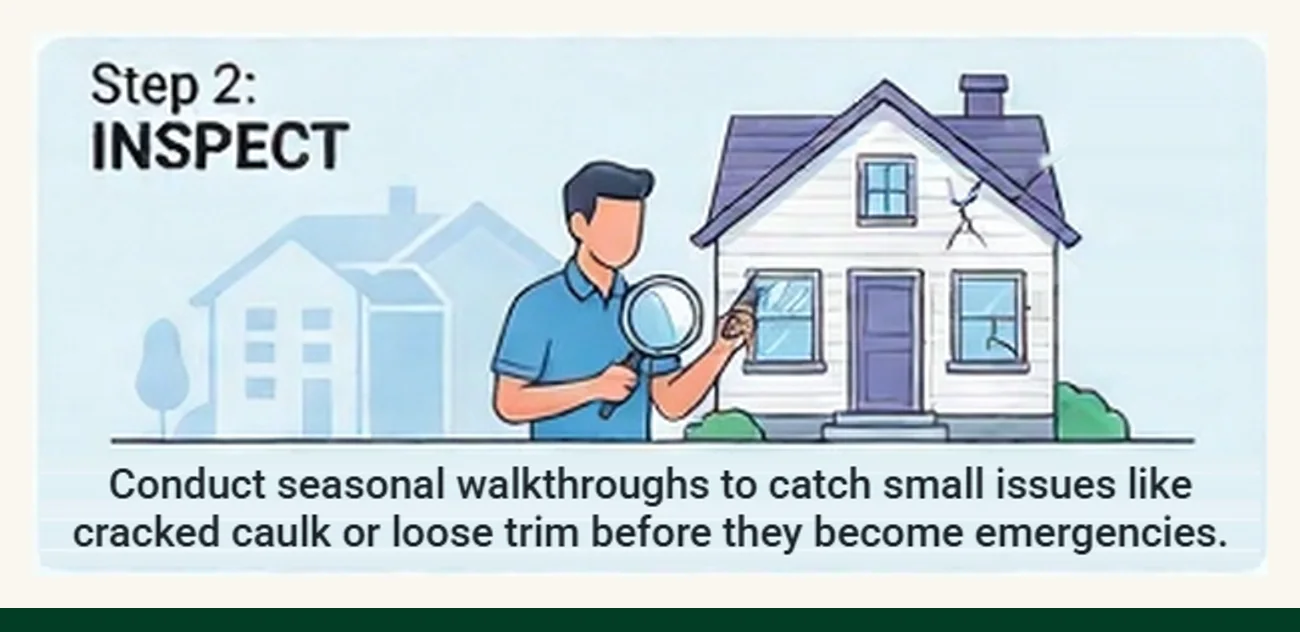
Conduct seasonal walkthroughs to catch small issues like cracked caulk or loose trim before they become emergencies.
You are here: Step 2, Inspect, in PHASE 1: AWARE (Know Before You Need). See the whole roadmap.
The gap
A clear, 9-step way to care for your home, from knowing it to building on it.
Where most homeowners are now
- The roof gets looked at when it leaks.
- Caulk, flashing and trim fail quietly for two or three winters before anyone notices the stain inside.
- The first warning is a repair bill, not a walk around the house.
Where this step puts you
- Four short walkthroughs a year, each one comparing the house to its baseline.
- Small things caught small: a bead of caulk, a loose downspout strap, a soft spot on a deck board.
- A standing list of what changed, so Step 4 has something real to prioritize.
What Inspect means
Inspect is the habit that makes the baseline worth having. Each season you walk the same route and ask one question of every system: has anything changed since last time? You are not looking for perfection. You are looking for the small, inexpensive failures that become large, expensive ones when water gets involved.
Clark County hands you the calendar. Fall is about keeping water out: gutters, downspout discharge, roof debris, caulk at windows and siding joints, the crawlspace vents. Winter is a check after the first big windstorm and the first hard freeze. Spring is where the winter showed: moss on the roof, paint failure on the south and west faces, soft wood on decks and trim. Summer is the dry window for paint, sealing and anything that needs a dry surface.
A walkthrough is a maintenance habit, not a licensed inspection, and it never replaces one for a sale or a purchase.
Do it yourself this season
- Pick a fixed route: start at the street, walk the exterior clockwise, then the interior room by room, then the attic and crawlspace.
- Bring your baseline. Compare, do not rediscover.
- Outside, look where materials meet: roof to wall, window to siding, deck to house, downspout to ground. Water gets in at joints.
- Inside, look at ceilings under bathrooms and at exterior corners, under every sink, around the water heater, and at the base of exterior doors.
- Photograph anything that changed and add it to the record with the date.
- Write a three line summary: what is new, what got worse, what to do before the next season.
How Handy Pioneers delivers Inspect
Seasonal Walkthrough. Two or four times a year, depending on the plan, on a fixed seasonal schedule.
- A technician walks the full Clark County seasonal checklist for that time of year.
- Findings compared against your baseline and logged with photos.
- The listed seasonal maintenance performed on the same visit.
- A written NOW, SOON and WAIT summary after every visit.
Essential includes spring and fall walkthroughs. Full Coverage and Maximum Protection include all four seasons. Compare the plans.
On your own, or with us
- Consistency. On your own: Depends on remembering, and on the weather the weekend you planned it. With Handy Pioneers: On the calendar every season, whether or not anything seems wrong.
- The roof. On your own: From the ground with binoculars, which is the right call for most people. With Handy Pioneers: Looked at properly, with the gear and the footing to do it safely.
- What you find. On your own: A list you still have to act on. With Handy Pioneers: Small items handled on the visit; the rest written up for Step 4.
- Cost of missing something. On your own: Yours, and usually discovered in February. With Handy Pioneers: A second set of trained eyes on the same house every season.
Common questions
How often should I walk through my house?
Every season, four times a year. If you can only manage two, make them fall (before the rain) and spring (after it). Those two catch most of what the Pacific Northwest does to a house.
What should a fall walkthrough in Clark County include?
Gutters and downspouts clear and discharging away from the foundation, roof clear of debris, caulk and flashing at windows and siding joints, exterior door seals, hose bibs protected, crawlspace vents and ground moisture checked, and a look at the attic for daylight or staining.
Should I go on the roof?
Most homeowners should not. Steep pitches, moss and wet shingles put people in the hospital every year. Use binoculars from the ground and from an upstairs window, and have a professional go up when something needs a closer look.
Is a seasonal walkthrough a home inspection?
No. It is a maintenance habit. A licensed home inspection is a formal report for a transaction. The walkthrough is what you do between those.
One step of nine
Previous: Step 1: Baseline
Next: Step 3: Track
Schedule your Baseline Walkthrough or turn an inspection report into a roadmap.
The 360° Method baseline and seasonal walkthroughs are proactive maintenance assessments by a trained home maintenance technician. They are not a licensed real estate home inspection and do not replace one. For a purchase or sale, engage a licensed home inspector.
The 360° Method™ and Proactive Path™, including the three-phase structure and the nine-step framework, are the proprietary methodology of Handy Pioneers. Any homeowner is welcome to use the steps on their own home.