Baseline: write your home down once, so it stops surprising you
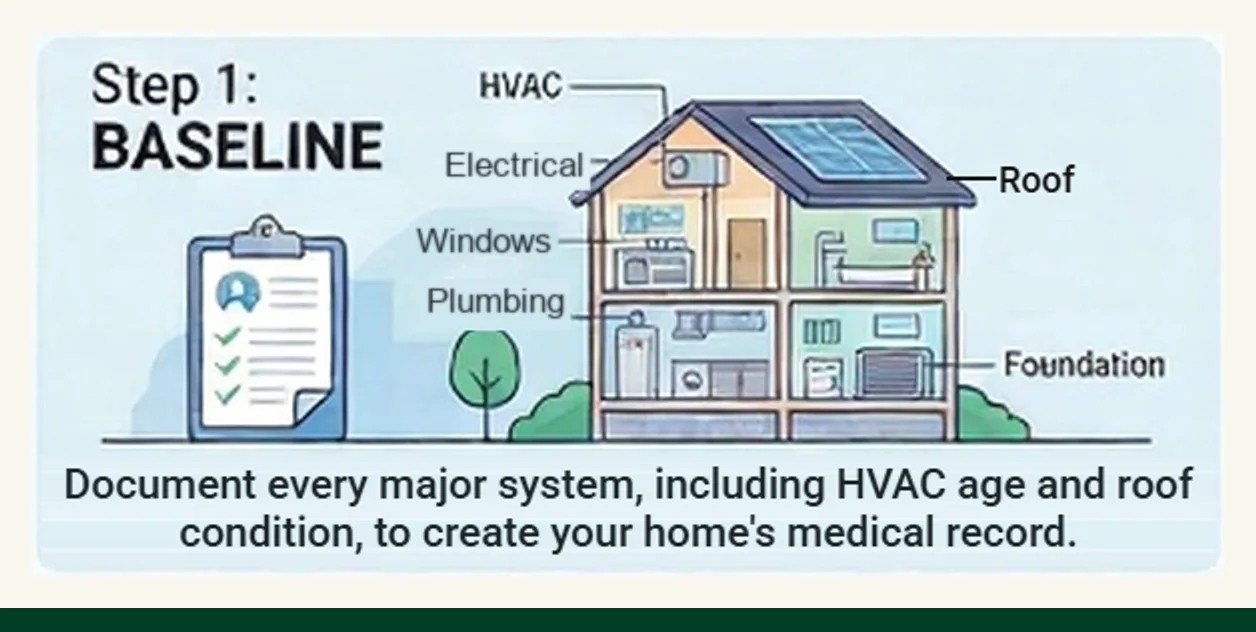
Document every major system, including HVAC age and roof condition, to create your home's medical record.
You are here: Step 1, Baseline, in PHASE 1: AWARE (Know Before You Need). See the whole roadmap.
The gap
A clear, 9-step way to care for your home, from knowing it to building on it.
Where most homeowners are now
- Nobody has looked at every system since the inspection you bought the house with.
- The age of the water heater, the furnace and the roof is a guess.
- Every repair starts from zero, with a stranger explaining your own house to you.
Where this step puts you
- Every major system documented once: what it is, how old it is, what shape it is in, with a photo.
- A starting record that each later visit builds on instead of replacing.
- Decisions made from facts about this house, not from the last emergency.
What Baseline means
A baseline is your home's medical record on day one. It does not fix anything. It answers one question for every major system in the house: what do we actually have here, and what condition is it in right now? Roof, gutters and drainage, siding and trim, windows and doors, foundation and crawlspace, attic and insulation, plumbing, water heater, electrical, heating and cooling, decks and exterior structures, and the interior finishes that tell you about the rest.
In Clark County the baseline matters more than in a drier climate. Nine wet months a year reward the house that was looked at in September and punish the one that was not. A baseline done once, in writing, is what turns the first seasonal walkthrough (Step 2) from a tour into a comparison.
The baseline is a maintenance record, not a licensed home inspection. If you are buying or selling, hire a licensed inspector. The baseline is what you keep after that report goes in a drawer.
Do it yourself this season
- Make a list of the major systems in your home. Twelve to fifteen lines is plenty.
- For each one, write down what it is and how old it is. Look for date stamps on the water heater, the furnace data plate, the electrical panel label and the roof permit.
- Walk the outside first, then the inside, then the attic and crawlspace. Rate each system in three words: good, watch, or needs attention.
- Take one wide photo and one close photo per system, including anything that worries you. Put the date in the file name.
- Note the brand and model of the big equipment so parts and manuals are findable later.
- Save the whole thing in one place you will find again: a shared folder, a notebook, or the home record in your portal.
How Handy Pioneers delivers Baseline
Home Baseline. Once, at the start of a membership, and refreshed when the home changes.
- A two to three hour documented walkthrough of every major system by a trained technician.
- Photos, condition ratings and the age of each system, stored in your home record.
- A written summary with findings sorted into NOW, SOON and WAIT.
- The record stays yours and follows the house.
The Home Baseline starts every Proactive Path plan: Essential, Full Coverage and Maximum Protection. Compare the plans.
On your own, or with us
- Time. On your own: A weekend, if you stay on task. With Handy Pioneers: One scheduled visit; you point out what worries you.
- Attic and crawlspace. On your own: You, a headlamp and a moisture meter, if you own one. With Handy Pioneers: Done by someone who goes in crawlspaces every week and knows what PNW moisture damage looks like early.
- Ratings. On your own: Your best judgment, which improves with practice. With Handy Pioneers: Consistent ratings across hundreds of Clark County homes, so good means the same thing every visit.
- Where it lives. On your own: A folder you maintain. With Handy Pioneers: Your portal home record, updated every seasonal visit.
Common questions
Is a home baseline the same as a home inspection?
No. A licensed home inspection is a point in time report for a real estate transaction, done by a licensed inspector. A baseline is the maintenance record you keep afterwards, built to be updated season after season. If you are buying or selling, hire an inspector. Then baseline the house you now own.
How long does a baseline take?
For a homeowner doing it alone, plan a weekend. A Handy Pioneers Home Baseline runs two to three hours on site for a typical Clark County home, with the written record delivered after.
What if I have no idea how old my roof or furnace is?
Look for a permit sticker on the roof or in the county permit record, a data plate on the furnace (the serial number usually encodes the year), and a label on the water heater. If there is no record, write down what you can see and mark the age as unknown. Unknown is still better than guessing.
Do I need special tools?
A flashlight, a phone camera and a notebook cover most of it. A moisture meter helps in a crawlspace. Anything that needs a ladder on a steep roof or opening an electrical panel is a reason to have a professional do that part.
One step of nine
Next: Step 2: Inspect
Schedule your Baseline Walkthrough or turn an inspection report into a roadmap.
The 360° Method baseline and seasonal walkthroughs are proactive maintenance assessments by a trained home maintenance technician. They are not a licensed real estate home inspection and do not replace one. For a purchase or sale, engage a licensed home inspector.
The 360° Method™ and Proactive Path™, including the three-phase structure and the nine-step framework, are the proprietary methodology of Handy Pioneers. Any homeowner is welcome to use the steps on their own home.