Track: one living record of every repair, visit and dollar
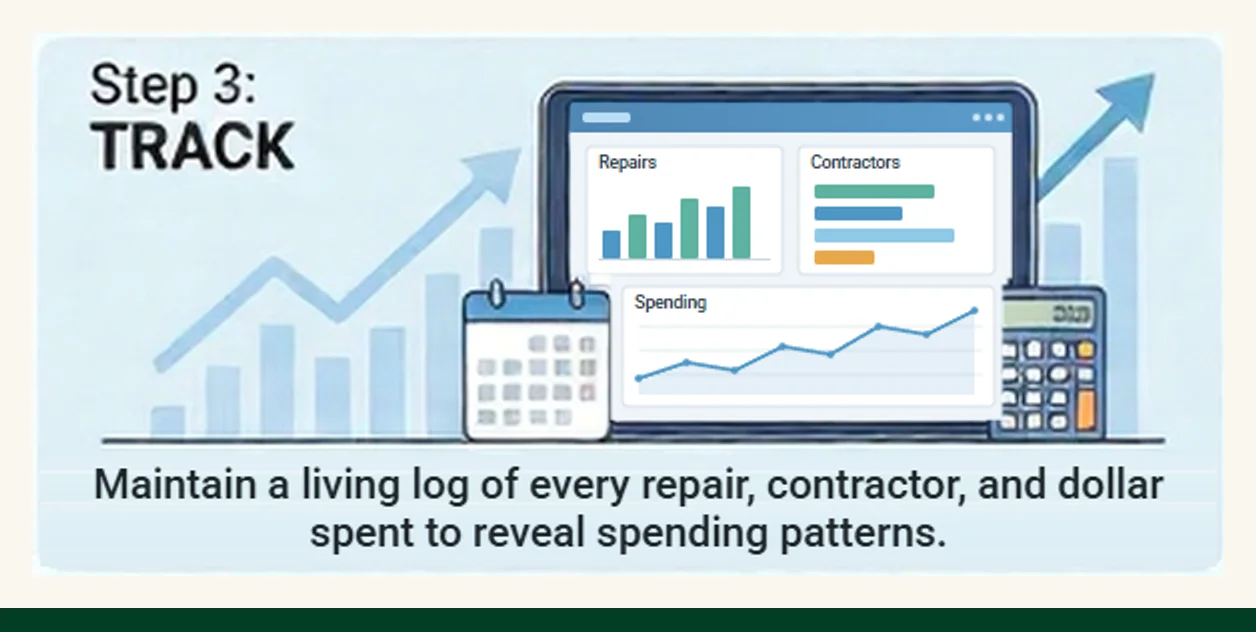
Maintain a living log of every repair, contractor, and dollar spent to reveal spending patterns.
You are here: Step 3, Track, in PHASE 1: AWARE (Know Before You Need). See the whole roadmap.
The gap
A clear, 9-step way to care for your home, from knowing it to building on it.
Where most homeowners are now
- Receipts in a drawer. Contractor names forgotten. The year the roof was done is a family debate.
- The same problem gets paid for twice because nobody remembers the first time.
- At sale, the buyer's inspector knows more about the house than the owner does.
Where this step puts you
- One record: what was done, when, by whom, what it cost, with photos.
- Patterns you can see: the system that keeps asking for money, the season that always bites.
- A documented history that supports a sale, a refinance or an insurance conversation.
What Track means
Track turns the baseline and the walkthroughs into a history. Every repair, every seasonal visit, every contractor and every dollar goes into one log, dated. It sounds like bookkeeping. It is actually the thing that makes the next two steps possible, because you cannot prioritize what you cannot see, and you cannot see a pattern from a drawer of receipts.
The log pays off in three places. Day to day, it stops repeat work and lost warranties. Over a few years, it shows you which systems are costing the most and which are quietly fine. And when the house changes hands, it is the difference between a seller who says the roof is fine and one who shows the invoice, the photos and the two walkthroughs since.
Do it yourself this season
- Start one file. A spreadsheet, a notes app or a binder. One is enough; two is where it falls apart.
- Give it five columns: date, system, what was done, who did it, what it cost. Add a photo link when you have one.
- Enter the baseline and every walkthrough summary as a row, so the record has a spine.
- Each time anyone works on the house, add a row the same day, before the invoice disappears.
- Once a year, sort by system and look at the totals. That is your spending pattern.
- Keep warranties and manuals in the same place, named by system.
How Handy Pioneers delivers Track
Home Health Record. Continuous. Updated on every visit and every job.
- Every walkthrough finding, photo and completed work order logged in your portal automatically.
- A system by system view of condition over time.
- Documents, photos and reports in one place that follows the house.
- Exportable when you sell, refinance or file a claim.
The Home Health Record is part of every Proactive Path plan: Essential, Full Coverage and Maximum Protection. Compare the plans.
On your own, or with us
- Discipline. On your own: The log is only as good as the habit, and the habit breaks in a busy month. With Handy Pioneers: Logged by the people doing the work, on the day.
- Photos. On your own: If you remember to take them, and can find them later. With Handy Pioneers: Before, during and after, attached to the entry.
- Patterns. On your own: Visible if you sort and total once a year. With Handy Pioneers: Visible on the home record, by system, any time.
- Resale. On your own: A folder you hand over. With Handy Pioneers: A documented history with dates, photos and reports.
Common questions
What should a home maintenance log include?
Date, system, what was done, who did it, what it cost, and a photo. Add warranties, manuals and the age of major equipment. Keep it in one place and add to it the day the work happens.
Does a maintenance record help when I sell?
It helps a buyer trust the house. Documented history answers the questions an inspection raises, and it shows a pattern of care rather than a pattern of fixes. Washington sellers still complete the required disclosure form; the log is what makes filling it out easy and defensible.
Paper or digital?
Whichever you will actually use. Digital wins on photos and search. Paper wins on simplicity. A member's portal record does both without the homeowner carrying the habit.
I have years of receipts and no log. Where do I start?
Start today, not with the backlog. Enter the baseline, then add rows going forward. Backfill the big items you can date (roof, furnace, water heater, windows) and let the rest go.
One step of nine
Previous: Step 2: Inspect
Next: Step 4: Prioritize
Schedule your Baseline Walkthrough or turn an inspection report into a roadmap.
The 360° Method™ and Proactive Path™, including the three-phase structure and the nine-step framework, are the proprietary methodology of Handy Pioneers. Any homeowner is welcome to use the steps on their own home.