Upgrade: Good, Better, Best, so every improvement dollar earns its place
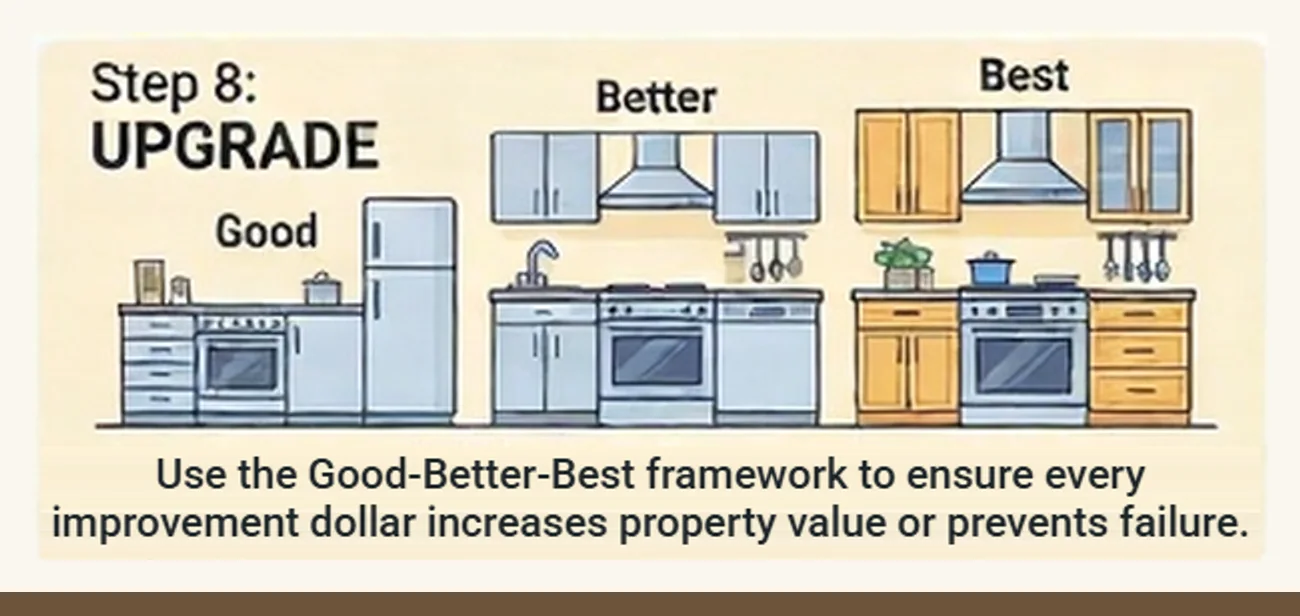
Use the Good-Better-Best framework to ensure every improvement dollar increases property value or prevents failure.
You are here: Step 8, Upgrade, in PHASE 3: ADVANCE (Build Wealth Through Property Care). See the whole roadmap.
The gap
A clear, 9-step way to care for your home, from knowing it to building on it.
Where most homeowners are now
- Improvement dollars spent on whatever caught your eye or whatever the neighbor did.
- A premium finish on a system that was about to fail underneath it.
- No way to tell a value upgrade from an expensive preference.
Where this step puts you
- Every improvement framed three ways, Good, Better, Best, with the trade-offs written down.
- Upgrades chosen because they prevent failure or raise value, not just because they are nice.
- Nice is still allowed. It is just chosen on purpose.
What Upgrade means
Upgrade is the step most people start with and the method puts eighth, on purpose. Improvements made on a house that is documented, maintained and preserved hold their value. Improvements made on a house with open NOW items are money poured over a problem. Once the foundation is in order, every improvement dollar gets one test: does it prevent a failure, or does it increase value?
The Good, Better, Best framework keeps the choice honest. For any project, write three versions. Good solves the problem soundly. Better adds durability or function that pays back. Best adds the finish and features you want. Then decide which level this house, this money and this horizon call for. Sometimes Best is right. The point is that you chose it knowing what Good would have cost.
In Clark County the value upgrades cluster around the envelope and the wet months: drainage, siding and trim done right, windows and doors that seal, decks built to last, and kitchens and baths done to a level the neighborhood supports.
Do it yourself this season
- Confirm the NOW list is closed. Upgrades wait until it is.
- For each project you are considering, write the Good, Better and Best version in a few lines each.
- Against each version, note what it prevents, what it adds and roughly how long you plan to own the house.
- Rank projects by what they do for the house first, and by what you want second.
- Get written scopes for the level you chose, in the right season for the work.
- Log the finished upgrade in the record with photos, invoices and warranties.
How Handy Pioneers delivers Upgrade
Smart Improvements. Planned in year two and beyond, once the home is stable.
- Good, Better, Best scopes written for the improvements on your roadmap.
- Plain explanation of what each level prevents or adds.
- Projects sequenced around the seasonal calendar and your horizon.
- The finished work documented in your home record.
Smart Improvements planning is part of every plan from year two: Essential, Full Coverage and Maximum Protection. Improvement projects are quoted separately in writing at the member rate and approved before any work starts. Most members reach this step in their second year, after the baseline, the first seasons of walkthroughs and the NOW list are behind them. Compare the plans.
On your own, or with us
- Three versions. On your own: Worth writing even if you only ever build Good. With Handy Pioneers: Scoped for you, with what each level prevents and adds.
- Sequence. On your own: Tempting to start with the kitchen. With Handy Pioneers: Ordered after the house is stable, so the upgrade holds its value.
- Market fit. On your own: Hard to judge from inside the house. With Handy Pioneers: Informed by what we see across Clark County homes.
- Record. On your own: Keep the invoices. With Handy Pioneers: Logged with photos and warranties in the home record.
Common questions
Which home improvements add value?
Ones that keep water out and the structure sound first (drainage, siding and trim, windows and doors, decks), then ones that bring the home to the level its neighborhood supports (kitchens, baths, flooring). An upgrade over an unfixed problem does not add value; it hides a cost.
What does Good, Better, Best mean for a project?
Three written versions of the same project. Good solves it soundly. Better adds durability or function that pays back. Best adds the finish and features you want. You choose the level knowing what the others cost.
Should I upgrade before I fix things?
No. Close the NOW list first. Improvements on a stable house hold their value. Improvements over open problems get torn out later.
Is Best ever the right choice?
Often, when you plan to stay, when the finish matters to you daily, or when the neighborhood supports it. The method does not say to choose Good; it says to choose on purpose.
One step of nine
Previous: Step 7: Preserve
Next: Step 9: Scale
Schedule a consultation or see the Proactive Path plans.
The 360° Method™ and Proactive Path™, including the three-phase structure and the nine-step framework, are the proprietary methodology of Handy Pioneers. Any homeowner is welcome to use the steps on their own home.