Preserve: routines that add years to the systems that cost the most
Implement system preservation routines to extend the lifespan of major appliances, like water heaters and HVACs.
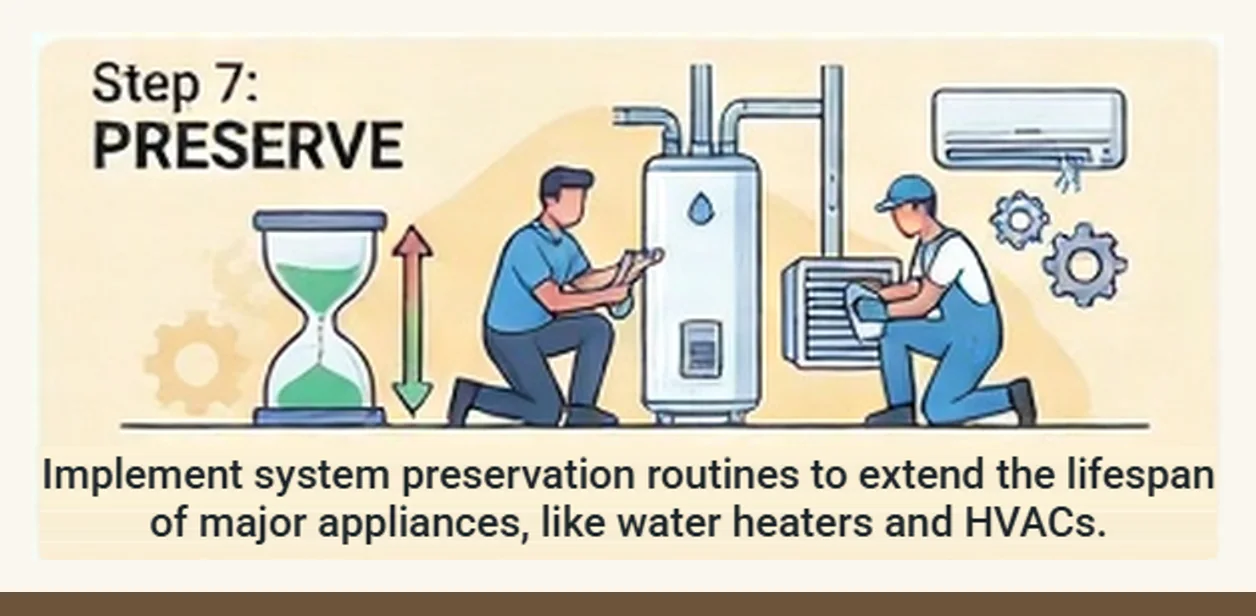
You are here: Step 7, Preserve, in PHASE 3: ADVANCE (Build Wealth Through Property Care). See the whole roadmap.
The gap
A clear, 9-step way to care for your home, from knowing it to building on it.
Where most homeowners are now
- Replacing the water heater early because nobody flushed it.
- A furnace that runs a decade less than it could, on dirty filters and no service.
- Siding and decks repainted because the last coat was left two summers too long.
Where this step puts you
- Simple, repeatable routines for each major system, on the calendar.
- Replacements that come later, planned, instead of early, in an emergency.
- The biggest line items in a home's lifetime cost pushed years down the road.
What Preserve means
Preserve is the move from fixing to extending. Once the house is documented, walked, prioritized, scheduled and the NOW list is handled, the next gain is making the expensive systems last. A water heater that is flushed and has its anode checked outlives one that is ignored. A furnace with clean filters and an annual service runs longer and cheaper. A roof kept clear of debris and moss, with gutters that drain, sheds water the way it was built to.
In Clark County the preservation routines are mostly about water and organic growth: keep the roof and gutters clear, keep moss off, keep paint and sealant intact so siding and trim stay dry, keep the crawlspace ventilated and the ground sloped away. The routines are not glamorous. They are the reason one house needs a new roof at twenty years and the house next door needs one at fourteen.
Do it yourself this season
- List your major systems with their age and expected service life. Water heater, furnace and air handler, roof, siding and exterior coatings, decks, windows.
- For each, write the two or three routines that extend it. Flush and anode check for the water heater. Filters and annual service for the furnace. Debris, moss and gutter care for the roof. Coating maintenance for siding and decks.
- Put the routines on the Care Calendar from Step 5, in the right season.
- Track them in the record. A system with a logged service history is worth more and fails less.
- Plan the replacement year for each system now, while it is a choice, and start setting money aside for it.
How Handy Pioneers delivers Preserve
Preventive Care. Built into the seasonal visits; service appointments coordinated annually.
- Preservation routines for the major systems worked into each seasonal checklist.
- Roof, gutter, moss and drainage care kept current through the wet season.
- Service history for each system logged in your home record.
- A projected replacement timeline so the big items are planned, not sudden.
Preventive Care is part of every plan: Essential, Full Coverage and Maximum Protection. Full Coverage and Maximum Protection cover more of the routines across four visits a year. Compare the plans.
On your own, or with us
- Water heater. On your own: A flush and an anode check are doable with care and the right valve. With Handy Pioneers: Done or coordinated on the visit, logged with the date.
- Roof and moss. On your own: From the ground, with the right treatment at the right time. With Handy Pioneers: Kept clear and treated in season, safely.
- Coatings. On your own: Catching failing paint early is the whole trick. With Handy Pioneers: Spotted on walkthroughs and booked into the dry window.
- Replacement timing. On your own: A guess, until it fails. With Handy Pioneers: Projected from age and condition, so it is planned.
Common questions
How do I make my water heater last longer?
Flush the tank yearly to clear sediment, check the anode rod every couple of years and replace it when it is mostly consumed, keep the temperature setting moderate, and keep the area around it dry and clear. Those routines commonly add years.
What shortens a roof's life in the Pacific Northwest?
Debris that holds moisture, moss that lifts shingles, gutters that back up under the edge, and shade that keeps the surface wet. Keeping the roof clear, treating moss early and keeping gutters draining are the preservation routines that matter here.
Is preventive maintenance really cheaper than replacing?
Preservation routines are small, recurring and predictable. Replacement is large and usually arrives at the worst time. The method does not promise a specific saving; it promises that the replacement comes later and on your schedule.
Which systems should I focus on first?
The ones that cost the most to replace and respond best to care: roof, water heater, furnace and air handler, and exterior coatings on siding, trim and decks.
One step of nine
Previous: Step 6: Execute
Next: Step 8: Upgrade
Schedule a consultation or see the Proactive Path plans.
The 360° Method™ and Proactive Path™, including the three-phase structure and the nine-step framework, are the proprietary methodology of Handy Pioneers. Any homeowner is welcome to use the steps on their own home.